


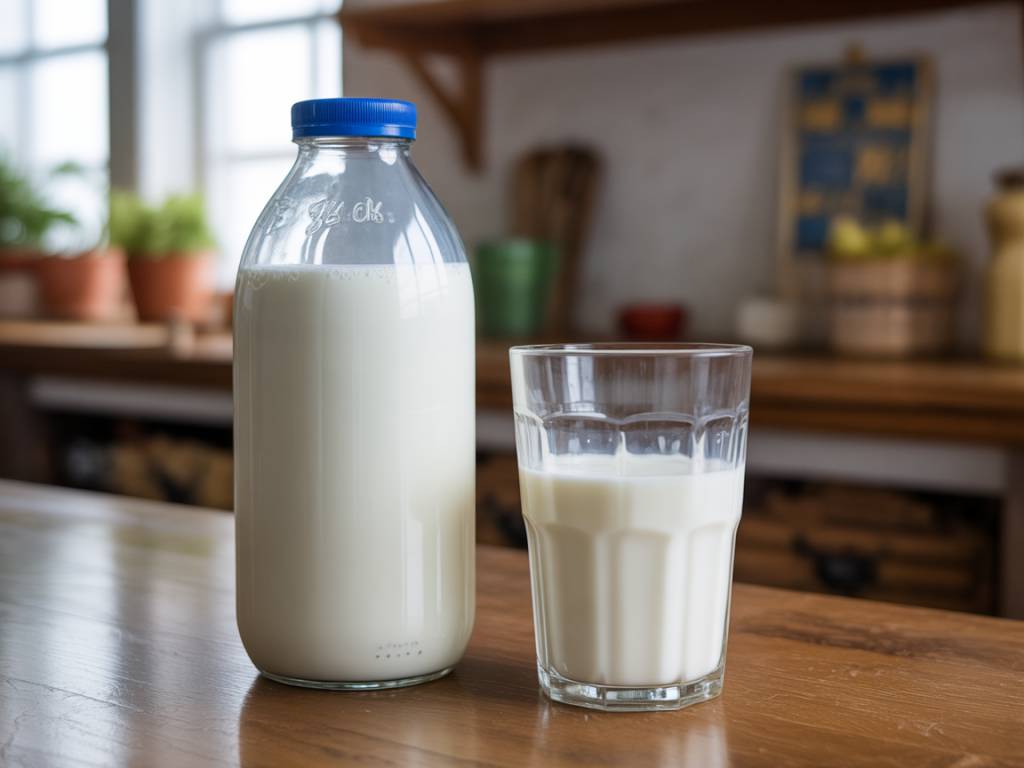
Walk down any dairy aisle and you’ll see it: skim milk, 1%, 2%, whole… and a quiet little war going on in your head. If you care about heart health and weight control, you’ve probably wondered whether 1% or skim milk is the better choice. Is “fat-free” automatically better, or does that small 1% of fat actually help you stay fuller and eat less overall?
Let’s break it down calmly, with what we know from nutrition science, and see how to choose the option that really serves your goals.
What changes between skim and 1% milk, really?
Both 1% and skim milk come from the same cow. The only real difference: how much fat is left in the bottle.
- Skim milk: Less than 0.5 g fat per 100 ml (practically fat-free).
- 1% milk: About 1 g fat per 100 ml (or ~2.5 g per cup).
That small difference in fat has a ripple effect on calories and texture:
- Calories (per 240 ml cup, approximate):
- Skim: ~80–90 kcal
- 1%: ~100–105 kcal
- Protein: Around 8 g in both – almost identical.
- Carbs (mainly lactose): Around 12 g in both – identical.
- Calcium & micronutrients: Very similar, often identical if the milk is fortified.
In other words, the only meaningful difference is about 20 kcal per cup and a small amount of fat. The question is: does that 1% fat help or harm your heart and your waistline over time?
Fat in milk: enemy or ally?
For decades, public health messages were simple: less fat = better for your heart and your weight. Today, the picture is more nuanced. We now know that:
- Dairy fat is a mix of saturated and unsaturated fats.
- Dairy foods also bring protein, calcium, potassium, and bioactive compounds that can offset some of the potential downsides of saturated fat.
- Several large studies show that moderate dairy intake is not associated with higher heart disease risk, and in some cases may even be linked to a slightly lower risk.
But we’re comparing 1% vs skim, not whole milk vs no milk. The saturated fat gap between these two is tiny. That means for heart health, the decision is much more subtle and depends on your overall diet and risk profile.
Skim vs 1% milk and heart health
Heart health is mostly influenced by your overall eating pattern: total saturated fat, fiber intake, ultra-processed foods, sodium, physical activity, genetics, and so on.
Here’s how 1% and skim milk fit into that bigger picture.
- Saturated fat difference is small: Going from 1% to skim saves you roughly 1–1.5 g of fat per cup, much of that saturated. Over one cup a day, that’s not a massive lever.
- Blood cholesterol responds to patterns, not single products: If your diet already contains fatty meats, butter, pastries, and minimal veggies, then yes, the total saturated fat load matters more than whether your milk is 1% or skim.
- Current evidence on low-fat vs regular dairy: Many observational studies show that total dairy (including low-fat and full-fat) is not clearly associated with increased cardiovascular disease. Some even suggest fermented dairy (yogurt, kefir, certain cheeses) may be heart-protective.
So who might benefit from choosing skim over 1% from a heart-health perspective?
- People with high LDL cholesterol or established heart disease, who are advised to keep saturated fat as low as realistically possible.
- Those who drink several large servings of milk daily; in that case, cumulative saturated fat from milk alone can add up.
For someone with generally good cardiovascular health and a balanced diet, the difference between 1% and skim is more of a fine-tuning than a game-changer.
What about weight control?
Weight control isn’t just math, but energy balance does matter: calories in vs calories out over time. Skim milk is lower in calories, so on paper it wins. But reality is more complex, because hunger and satiety can change how much you eat later.
Let’s look at both sides.
Why skim milk can help with weight control
- Fewer calories per serving:
- 1 cup skim: ~80–90 kcal
- 1 cup 1%: ~100–105 kcal
If you drink 3 cups a day, that’s a difference of ~60 calories. Over a month, that can sum up – especially if your weight is very stable and your intake is close to your maintenance level.
- High protein, low calorie: Skim milk gives you the same ~8 g protein per cup for fewer calories, making it a very efficient protein source for those on a tight calorie budget (cutting phase, weight loss program, or athletes managing specific weight categories).
- Easy to integrate into recipes: In smoothies, porridge, or baking, you can save calories without changing taste drastically, especially if other ingredients provide texture and flavor.
Why 1% milk might actually support better appetite control
Fat slows gastric emptying and can help you stay fuller for longer. That tiny bit of fat in 1% milk can make the drink feel more satisfying, creamier, and less “watery” than skim.
- Better satiety: Some people report that skim milk leaves them hungry sooner, leading them to snack more. A slightly richer milk can curb small cravings later in the day.
- Taste matters: If you dislike skim milk, you might add sugar, flavored syrups, or drink larger portions to compensate. In that case, the theoretical “calorie savings” vanish quickly.
- Sticking to your plan: A nutrition strategy that feels too restrictive is rarely sustainable. If 1% milk helps you enjoy your coffee, breakfast cereal, or post-workout shake more, you’re more likely to stick with your habits long-term.
Paradoxically, some observational studies have found that people who consume low-fat dairy are not always leaner than those who drink regular-fat dairy. Why? Possibly because of compensation: more snacks, larger portions, or more added sugar.
The takeaway: skim milk can help when calories are carefully managed, but 1% may win in real life if it improves satisfaction and reduces later overeating.
Practical scenarios: when to choose which?
To make this truly useful, let’s look at concrete situations you might recognize.
- You’re on a strict fat or calorie budget (e.g., cutting weight, preparing for a sporting event, or managing very high LDL cholesterol).
- Skim milk is usually the better fit. You get quality protein and calcium with minimal added calories and fat.
- You’re moderately active, healthy, and want to maintain or gently reduce weight.
- 1% milk is often a great middle ground: more taste than skim, far less fat than whole milk.
- You drink a lot of milk during the day (cereal + coffee + smoothie + cooking).
- Here, the cumulative calories count. If it adds up to 3–4 cups daily, skim may be strategically useful.
- You’re often hungry and snacky between meals.
- 1% milk might help your breakfast or snack keep you full for longer than skim, especially when combined with fiber (oats, whole grains, fruit).
- You have a strong preference in taste.
- If you genuinely dislike skim, forcing yourself to drink it is rarely worth the minor calorie difference. Choose 1% and adjust elsewhere (e.g. fewer liquid calories from juices or sodas).
Impact on sports performance and recovery
For athletes and active people, milk is more than a breakfast drink – it can be a recovery tool.
- Protein for muscle repair: Both skim and 1% milk provide high-quality proteins (whey + casein), essential for muscle recovery and adaptation to training.
- Carbs for glycogen: The lactose helps replenish glycogen stores after long or intense sessions.
- A bit of fat in 1% milk: Not crucial for recovery, but it can help make post-workout shakes more palatable and slightly more energy-dense, which is useful for athletes who struggle to meet their caloric needs.
If your priority is very lean body composition (e.g., bodybuilding competition, weight-class sports at low body fat), skim milk might give you more precise control over macros. For most recreational athletes, though, the difference between skim and 1% is marginal compared to total intake, sleep quality, and training consistency.
Vitamins, minerals, and the “fat-soluble” question
Both skim and 1% milk are typically fortified with vitamins A and D in many countries. These are fat-soluble vitamins, but food manufacturers take this into account when fortifying.
- Calcium: Essentially the same in skim and 1% milk.
- Vitamin D and A: Often added back in similar quantities, regardless of fat level.
- Bioavailability: The tiny bit of fat in 1% milk might slightly favor absorption of fat-soluble vitamins, but in practice, if you eat any other fat in the same meal (nuts, olive oil, eggs, etc.), absorption from skim milk will also be adequate.
In daily life, the difference in micronutrient impact between skim and 1% milk is negligible if your overall diet is varied and includes some healthy fats.
How to integrate your choice into a heart-healthy, weight-friendly diet
Regardless of whether you go for skim or 1%, the real power lies in the context of your entire plate. To protect your heart and manage your weight, it’s wise to:
- Prioritize whole, minimally processed foods (vegetables, fruits, legumes, whole grains, nuts, seeds).
- Choose lean proteins (fish, poultry, legumes, tofu, eggs in moderation, low-fat dairy).
- Use healthy fats (olive oil, avocado, nuts) rather than trans fats or large amounts of butter.
- Limit added sugars, sweetened drinks, and ultra-processed snacks.
- Stay active: combine cardio, resistance training, and daily movement.
Then, milk becomes a detail you adjust to match your profile:
- Need to reduce saturated fat? Push towards skim.
- Need more satiety and enjoyment while still moderating fat? 1% is an excellent compromise.
A quick word on personal tolerance and alternatives
Of course, some people simply don’t tolerate cow’s milk well (lactose intolerance, digestive discomfort) or avoid it by choice.
- Lactose-free cow’s milk: Available in both skim and 1% versions; same logic applies for heart health and weight control.
- Fortified plant-based drinks (soy, pea, some oat drinks):
- Look for options fortified with calcium, vitamin D and B12.
- Choose unsweetened versions to avoid unnecessary sugar.
- Protein varies widely: soy and pea are closest to cow’s milk; many others are lower in protein.
The skim vs 1% debate is specific to dairy, but the underlying question is the same with any milk alternative: What helps you meet your nutritional needs while fitting your preferences and your health goals?
So which is “better” – 1% or skim milk?
If you were hoping for a dramatic winner, you might be a bit disappointed. In reality:
- For strict calorie or saturated fat reduction: Skim has a small edge.
- For taste, satisfaction, and realistic long-term adherence: 1% often wins.
- For heart health: The difference between the two is minor; your overall eating pattern, exercise, and lifestyle matter far more.
- For weight control: Skim can help on paper, but 1% may help you feel more satisfied and avoid compensatory snacking.
Here’s a simple way to decide right now:
- If you’re currently drinking whole or 2% milk and want to improve heart-health markers or support weight loss, switching to 1% is already a big step.
- If you’re already on 1% and want to tighten your calorie or saturated fat budget a bit more, test skim milk for a few weeks and see how your hunger, energy, and enjoyment respond.
- If taste is the main barrier, stay with 1% and adjust calories elsewhere – you’ll likely stick with it longer and get better results overall.
In nutrition, the “perfect” choice is the one that balances science with your reality. For most people invested in heart health and weight control, 1% and skim milk are both solid, health-supportive options. The real power comes from choosing the one you can enjoy consistently, while building the rest of your diet – and your lifestyle – around long-term, sustainable habits.