


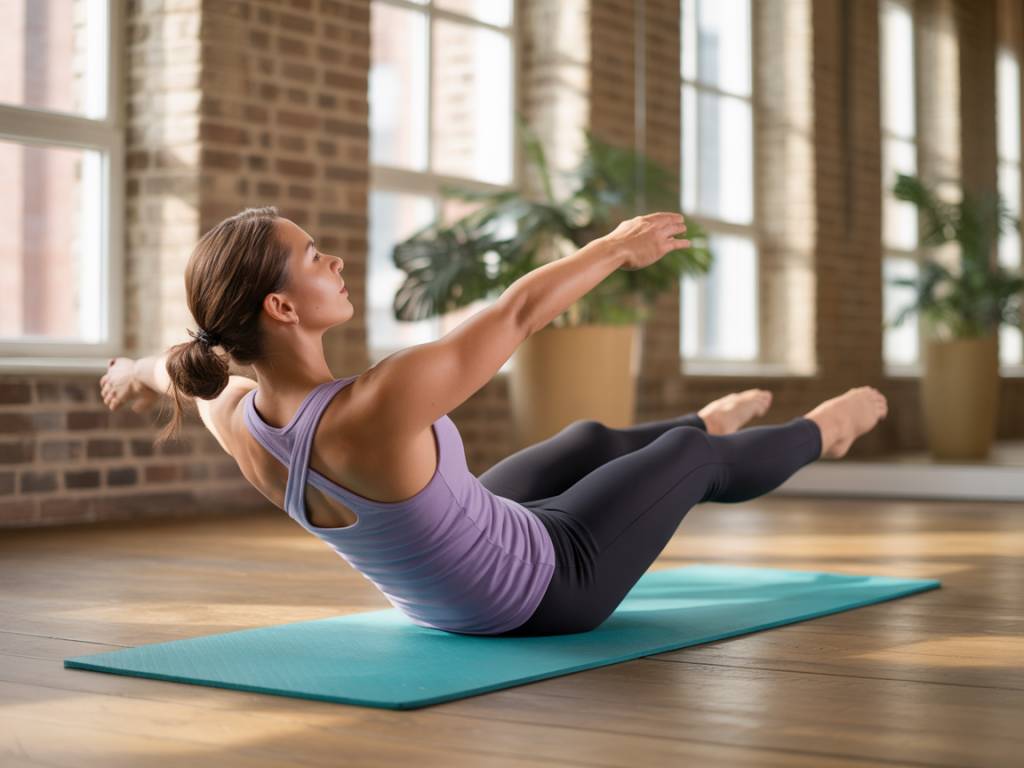
Pilates has a bit of a reputation problem. Some people still imagine a gentle “stretch class” with soft music and zero sweat. In reality, a well-taught Pilates session can light up your core, open your hips and shoulders, and do wonders for a stiff, achy back.
If you’re looking to build real core strength, improve flexibility, and finally do something about that nagging lower back pain, Pilates deserves a place in your routine. Let’s look at how it works and what you can realistically expect from it.
What makes Pilates different from regular ab workouts?
Pilates isn’t just about “doing abs”. It’s a method created to train your whole body from the inside out, starting with what Joseph Pilates called the “powerhouse”: your core, pelvis, and hips.
Instead of cranking out endless crunches, Pilates focuses on:
- Controlled, precise movements (no swinging, no momentum)
- Deep breathing coordinated with each exercise
- Spinal alignment and joint positioning
- Balanced strength between front and back of the body
- Quality of movement over quantity of reps
The result: you don’t just feel stronger; you move better. And that’s exactly why Pilates is so effective for core strength, flexibility, and back pain relief.
A stronger, smarter core (not just “six-pack” muscles)
Most ab workouts target the superficial muscles you can see – mainly the rectus abdominis (the “six-pack”). Pilates goes deeper.
Many classic Pilates exercises target:
- Transverse abdominis: your natural “corset” that stabilizes your spine
- Multifidus: deep muscles along your spine that protect each vertebra
- Obliques: for rotation, anti-rotation, and side bending
- Diaphragm and pelvic floor: crucial for breathing and core stability
By recruiting these deep stabilizers, Pilates helps you build a core that supports you when you run, lift, sit, stand, carry groceries, or pick up your kids. It’s not just “stronger abs”; it’s a more intelligent, integrated core.
Improved posture and spinal alignment
Hours spent sitting at a desk, driving, or scrolling on your phone tend to pull you into the same posture: rounded shoulders, forward head, and a stiff or overarched lower back.
Pilates addresses this head-on by:
- Strengthening the upper back and postural muscles
- Opening tight chest and hip flexor muscles
- Teaching you how to lengthen your spine instead of compressing it
- Reinforcing neutral pelvis and neutral spine positions
Over time, you start to feel taller, more open across the chest, and less “collapsed” in your lower back and neck. Many people report that they automatically sit and stand differently after a few weeks of consistent practice – without constantly reminding themselves to “stand up straight”.
Flexibility with control (not passive stretching)
Pilates doesn’t treat flexibility as an isolated goal. You’re not just trying to touch your toes; you’re learning to move through a fuller range of motion with strength and control.
This is a key difference from passive stretching. In Pilates, you typically:
- Move a joint gradually through its range while keeping the rest of the body stable
- Engage muscles as you lengthen them (eccentric strengthening)
- Pair movement with breath to reduce tension and guarding
The result is functional flexibility: hips that rotate freely, hamstrings that don’t scream every time you bend forward, shoulders that can reach overhead without your neck tensing up. You don’t just become “bendy”; you become more mobile and resilient.
Gentle but powerful relief for back pain
Back pain is one of the most common reasons people discover Pilates – and one of the main reasons they stay.
Here’s why the method works so well for many types of non-specific back pain:
- Core stability: Strong deep abdominals act like a built-in support belt for the spine.
- Spinal mobility: Controlled flexion, extension, rotation, and side bending restore movement to stiff segments.
- Postural balance: Strong glutes and upper back help take pressure off the lower back.
- Reduced muscular tension: Focused breathing and slower, mindful movement calm overactive muscles.
Many studies now support the use of Pilates-based exercise for chronic lower back pain. It’s not magic, but for a lot of people, it’s the first time they feel their spine supported instead of stressed during exercise.
Important reminder: if you have severe or specific spinal issues (disc herniation, stenosis, recent surgery, etc.), talk to a health professional first and work with a qualified Pilates teacher who can adapt exercises.
Better pelvic floor function and stability
Pilates is often recommended for postpartum recovery, urinary leakage, and general pelvic health – and with good reason. The pelvic floor is a key player in core stability.
In Pilates, you learn to:
- Coordinate pelvic floor activation with your breathing
- Engage deep abs without “pushing down” on the pelvic floor
- Stabilize your pelvis during leg and hip movements
This can help with:
- Reducing pressure and discomfort in the lower back and pelvis
- Improving bladder control
- Restoring confidence in movement after pregnancy or injury
Even if pelvic health isn’t your primary concern, this integrated approach gives you a more stable, efficient center of gravity for all your movements.
Breathing that calms the nervous system
Most of us don’t think about how we breathe during a workout. In Pilates, breathing is central to every exercise. Typically, you use lateral (ribcage) breathing: expanding the ribs to the side and back on the inhale, and gently engaging the deep core on the exhale.
This has several benefits:
- More oxygen to working muscles
- Improved rib and thoracic spine mobility
- Reduced neck and upper chest tension from shallow breathing
- Activation of the parasympathetic nervous system, which helps reduce stress and anxiety
Many people leave a Pilates class feeling both worked and relaxed – like they’ve trained and meditated at the same time. For anyone dealing with stress-related back tension, this combination can be especially powerful.
Better performance in sports and daily workouts
If you already run, lift weights, cycle, swim, or play a sport, Pilates can act like a performance “multiplier”. Because it improves both stability and mobility, it helps you generate more power with less wasted effort.
Some carryover effects you might notice:
- Running: improved posture, reduced bouncing and twisting, fewer side stitches
- Strength training: better bracing, safer squats and deadlifts, more control in overhead movements
- Cycling: less neck and lower back fatigue from long rides
- Racquet or rotational sports: more efficient rotation from the torso instead of overusing the lower back or shoulders
This is why many professional athletes quietly include Pilates or Pilates-inspired work in their off-season and rehab programs. It fills in the gaps that sport-specific training can leave behind.
Enhanced body awareness and balance
In Pilates, you’re constantly asked questions like: “Where is your pelvis?” “Can you keep your ribs down?” “Can you move your leg without moving your lower back?”
At first, this can feel overwhelming. Then something interesting happens: you begin to feel your body more clearly.
This improved proprioception (body awareness) leads to:
- Better balance and coordination
- Earlier detection of “warning signs” (tightness, asymmetry, fatigue)
- More efficient movement patterns in everyday life
Over time, you’re less likely to twist awkwardly when lifting something, trip over your own feet, or ignore signals that a particular part of your body needs attention.
Low-impact and adaptable for every fitness level
One of the biggest advantages of Pilates: it’s truly scalable.
Because movement is slow, controlled, and low-impact, it’s suitable for:
- Beginners who haven’t exercised in a long time
- People with joint pain or past injuries (with proper guidance)
- Older adults who want to stay active without high-impact stress
- Athletes who need focused, low-impact conditioning and recovery
The same exercise can be made easier or harder by adjusting range of motion, leverage, support, or equipment. No matter where you’re starting from, there’s a way in.
Real-world benefits you feel outside the studio
It’s great to feel strong during class, but the real test is how you feel the rest of the week. That’s where Pilates really shines.
People who practice regularly often report:
- Less stiffness when getting out of bed in the morning
- More comfortable sitting at a desk or driving
- Fewer episodes of “my back just went out”
- More energy and mental clarity throughout the day
- A general feeling of being “held together” instead of falling apart
These changes might seem subtle at first, but add them up over months and years, and you’re looking at a real shift in how you age, move, and feel in your own body.
Mat Pilates or reformer: which should you choose?
If you’re new to Pilates, you’ve probably seen both mat classes and reformer sessions offered. Which one is “better”?
Mat Pilates:
- Uses your own bodyweight (sometimes small props: bands, balls, rings)
- Great for learning fundamentals
- Easy to practice at home with minimal equipment
- Can be very challenging when properly taught
Reformer Pilates:
- Uses a spring-loaded machine to add resistance or support
- Helps you find better alignment and control
- Highly adaptable for rehab or advanced training
- Usually requires a studio and a qualified instructor
You don’t need a reformer to get serious benefits. For core strength, flexibility, and back health, consistent mat work is more than enough to transform how you feel.
How often should you do Pilates to see results?
Like any form of training, Pilates works if you do it consistently. You don’t need daily 60-minute sessions; you just need regular exposure.
A realistic plan could look like:
- 2–3 sessions per week of 30–50 minutes
- Short “maintenance” sessions of 10–15 minutes on busy days
- Mixing studio classes with home practice (videos or simple routines)
Most people start to notice changes in posture, ease of movement, and core engagement within 3–4 weeks. Back pain and flexibility improvements often show up gradually over 6–8 weeks of steady practice.
Getting started safely and effectively
If you’re ready to give it a try and want to protect your back while getting stronger, here are a few practical tips:
- Start with fundamentals. Look for “beginner” or “foundations” classes that focus on breathing, neutral spine, and basic core engagement.
- Skip the ego. If an exercise bothers your back or neck, ask for a modification. Quality of movement matters more than doing the hardest variation.
- Listen to your body. Mild muscular effort or fatigue is normal; sharp pain, pinching, or numbness is not.
- Combine with daily movement. Pilates pairs well with walking, light strength training, and general activity.
Over time, the goal isn’t to become “good at Pilates” for its own sake. It’s to use Pilates as a tool so your core is stronger, your spine moves more freely, and your back becomes something you trust again instead of fear.
If your current routine leaves you feeling stiff, sore, or stuck at your desk with a complaining lower back, Pilates might be the missing piece. A mat, a bit of space, and a willingness to explore your own movement patterns can be enough to start rewriting the way your body feels, one controlled breath at a time.