Squats are often called the “king of exercises” for a reason. With a simple movement that your body was literally designed to perform, you can build strength, burn fat, protect your joints, and age more gracefully. Not bad for something you can do in your living room without any equipment.
In this article, we’ll explore 10 key benefits of squats for strength, fat loss, and healthy aging, plus clear tips to get started safely—whether you’re 20, 50, or 70.
What exactly is a squat?
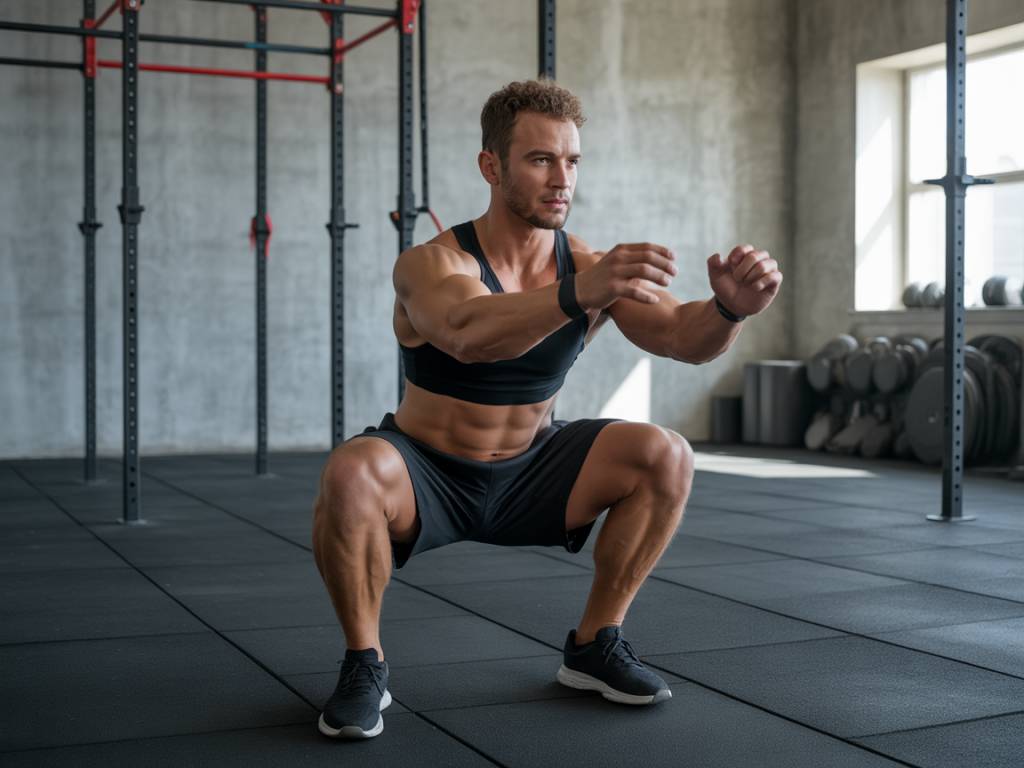
Before talking benefits, let’s clarify what we’re dealing with. A basic bodyweight squat looks like this:
That’s it. No fancy machines. Just your body moving the way it’s supposed to move.
Build serious lower-body strength
Squats target several major muscle groups at the same time:
By working so many muscles together, squats are one of the most efficient strength builders you can do. Unlike isolated exercises (like leg extensions), squats mimic real-life movements—standing up, sitting down, lifting objects—so the strength you gain translates directly to everyday life.
For example, if you struggle to stand up from low chairs or feel your legs “burn” after stairs, improving your squat strength can make those tasks dramatically easier within a few weeks.
Boost fat loss and metabolism
Squats burn calories during the workout, of course. But their real power lies in what happens afterward.
Because squats use so many large muscles at once, they stimulate your body to build and maintain lean muscle mass. And muscle is metabolically active tissue—it burns more calories at rest than fat does.
This means that by regularly including squats in your week, you can:
Pairing squats with a protein-rich diet and reasonable calorie intake creates an ideal environment for fat loss while keeping your body strong and functional.
Protect your joints instead of “ruining” them
You may have heard people say, “Squats are bad for your knees.” When done with poor technique or too much load, that can be true. But when performed correctly, squats can actually protect your joints.
Here’s why:
Research generally shows that appropriately loaded squats do not harm healthy knees. In fact, athletes and older adults who squat with proper form often report fewer aches and pains over time.
If your knees are sensitive, you can adjust:
Think of squats as a way to “nourish” your joints, not punish them.
Support healthy aging and independence
One of the clearest predictors of independence as we age is lower-body strength—especially the ability to stand up from a chair without using your hands.
And what is standing up from a chair? A squat.
Regular squatting helps you:
In studies on older adults, strength training with movements like squats is consistently linked to better quality of life, more autonomy, and even reduced risk of all-cause mortality.
If you want to be the 80-year-old who still gets up from the floor easily and enjoys travel, squats are an excellent investment.
Strengthen your core (without endless crunches)
During a squat, your core has one crucial job: keep your spine stable while your hips and knees move.
To do that, your body recruits:
This kind of “functional core training” is far more useful for daily life than hundreds of crunches. You’re teaching your body to resist unwanted movement and transfer power efficiently between your upper and lower body.
Result? Better posture, reduced risk of lower back pain, and a stronger, more stable midsection.
Improve balance, coordination, and body awareness
Squats are not just about muscles; they also train your nervous system.
Each rep requires you to coordinate many joints and muscle groups while staying balanced on your feet. Over time, this improves:
This is especially valuable as we age, when balance naturally tends to decline. Better balance means fewer trips, fewer falls, and more confidence when moving on uneven ground or in crowded places.
Enhance sports performance and everyday power
If you practice any sport—running, cycling, football, tennis, skiing—squats can make you better at it.
Why? Because they build the engine of athletic performance: strong, powerful legs and hips.
Regular squats can help you:
Even if you’re not an athlete, “power” matters. It’s what lets you quickly step out of the way of a car, catch yourself during a slip, or lift something heavy without straining.
Support bone density and protect against osteoporosis
Bone, like muscle, responds to stress. When you load your skeleton—through resistance training like squats—it adapts by becoming stronger and denser.
This is particularly important for:
Weight-bearing exercises such as squats stimulate bone formation, especially in areas prone to fractures: hips, femurs, and spine. Combined with adequate calcium, vitamin D, and protein intake, they form a powerful prevention strategy against osteoporosis.
Time-efficient, scalable, and accessible to everyone
One of the underrated benefits of squats: they’re practical.
You can do them:
And they are infinitely scalable. Depending on your level, you can choose:
Whatever your starting point, there is a squat variation that fits you today—then you can gradually increase difficulty as you progress.
Boost mood, energy, and mental resilience
We often talk about the physical benefits of squats, but the mental side is just as interesting.
Like other forms of exercise, squats can:
There’s also a psychological effect in regularly performing a movement that was initially difficult. When you realize that you can now do 10, 20, or 30 good squats when before you struggled with 5, it reinforces a powerful message: you are capable of changing your body and your health.
How to squat safely: key technique tips
To fully enjoy the benefits of squats, form matters. Here are the essentials:
Resist the urge to load up too quickly. Master the movement first, then add difficulty.
Stand with feet about shoulder-width apart. Slightly turn your toes outward. Everyone’s hip anatomy is different; adjust until the movement feels natural and pain-free.
Take a breath, lightly tighten your abs as if preparing to be poked, and keep your chest open without over-arching your lower back.
Think “hips back, then down,” like sitting into a chair. This helps protect your knees and keep balance.
If your heels lift, reduce depth or widen your stance slightly. You can also elevate your heels on small plates as a temporary mobility aid.
There is no universal “perfect” depth. Aim for a pain-free range where you can maintain control and good alignment. Over time, your range often improves.
On the way up, press evenly through your whole foot, especially mid-foot and heel. Imagine pushing the floor away from you.
A simple squat routine to start today
Here’s a beginner-friendly session you can do 2–3 times per week. No equipment required.
Warm-up (5 minutes)
Main set
If 3 sets feel easy, add:
Progression ideas
The goal is not to destroy your legs on day one, but to build a sustainable habit. You should feel that you’ve worked, but still be able to walk the next day.
Common mistakes to avoid
A few frequent errors can limit results or increase the risk of discomfort. Watch out for:
Think about gently pushing your knees out in the same direction as your toes.
If this happens, reduce range of motion and work on hip and ankle mobility.
Use a simple rhythm: inhale before you go down, exhale as you stand up.
Slow, controlled squats are more effective and safer than fast, sloppy ones.
How to integrate squats into your weekly routine
You don’t need complex programming. Here are a few easy ways to implement squats:
Do 10 squats every time you make a coffee or take a short break from your desk. Accumulated over the day, this can easily reach 50–100 reps without a formal workout.
For example:
Combine squats with upper-body and core exercises (push-ups, rows, planks) for a complete workout 2–3 times per week.
The “best” approach is the one you’ll actually stick to. Consistency beats perfection.
Key takeaways
Squats offer an impressive list of benefits:
You don’t need a gym membership, fancy shoes, or the “perfect” program to start. Choose a variation that feels safe, follow the basic technique tips, and commit to a few sessions per week. Your future self—stronger, leaner, and more resilient—will thank you.